
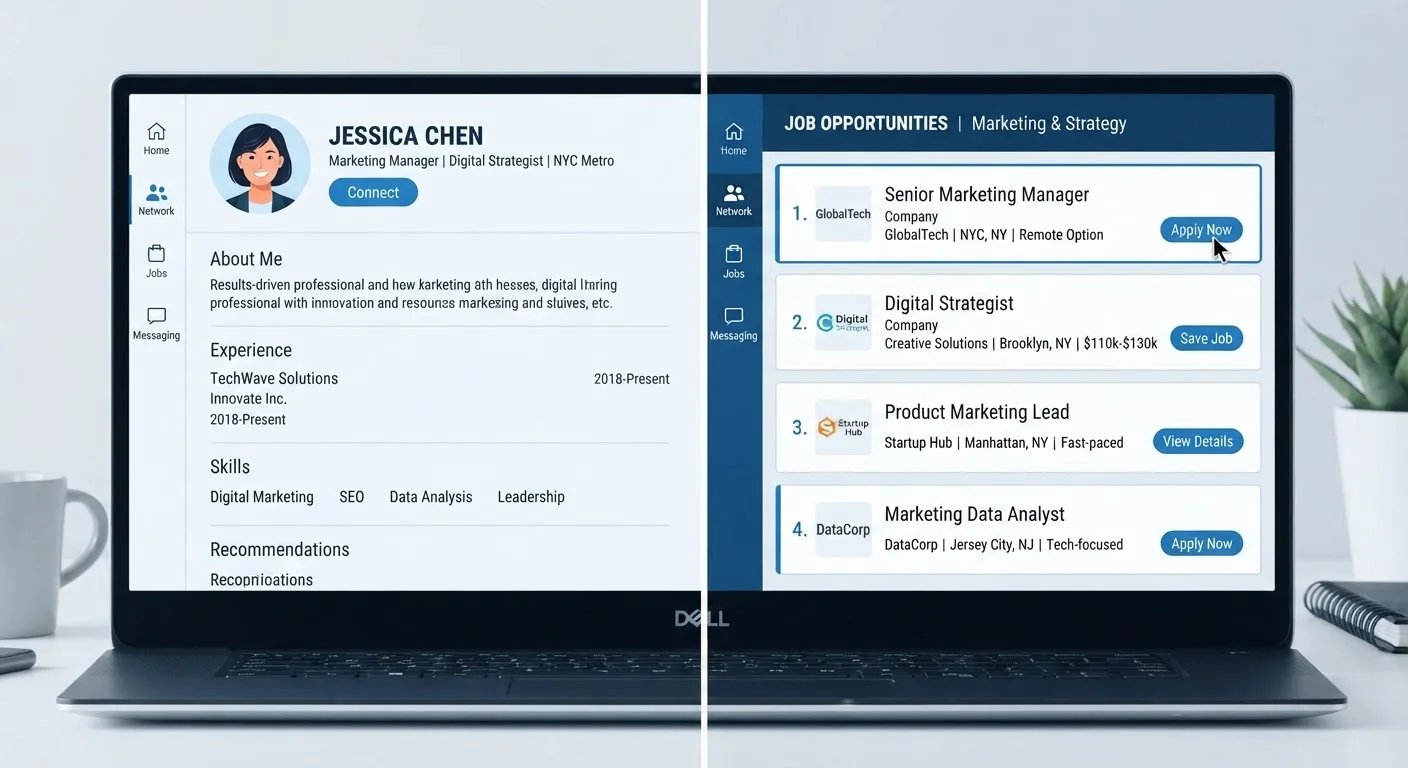
What Each Platform Is Actually Built For
Job seekers often treat LinkedIn and job boards as interchangeable - scroll, click, apply. But they're built on fundamentally different models, and that shapes how useful each one is at different stages of your search.
LinkedIn is a professional network first. Its job listings are a feature layered on top of a social graph of 900+ million members. That means your activity on LinkedIn - your profile completeness, your connections, your engagement - directly affects how visible you are to recruiters who aren't waiting for you to apply.
Job boards like Indeed, ZipRecruiter, and Glassdoor are structured differently. They're built to aggregate and surface postings efficiently. Their value is breadth and speed: you can filter by location, salary, experience level, and job type, and see hundreds of relevant openings in minutes. What they don't do is build your professional identity or put you in front of people before a job is posted. See what the evidence says about unlisted roles for context on why that distinction matters.
| Criterion | Job Boards | |
|---|---|---|
| Primary function | Professional networking | Job listing aggregation |
| Recruiter visibility | High - proactive inbound possible | Low - you must apply first |
| Volume of listings | Moderate | Very high |
| Salary data | Limited | Often included or linked |
| Profile/identity building | Yes - core feature | No |
| Direct employer contact | Yes, via messaging | Rarely |
| Ghost listing risk | Present but moderated | Higher |
| Best for small/local employers | Inconsistent | Strong |
Where LinkedIn Has a Real Edge
LinkedIn's most underused feature isn't its job board - it's the visibility your profile creates. When a recruiter searches for candidates with a specific skill set, they're using LinkedIn's search, not Indeed's. A fully built-out profile with relevant keywords, clear role history, and an active presence can generate inbound recruiter messages without you applying anywhere.
LinkedIn also lets you research hiring managers, find mutual connections at target companies, and send direct messages - all of which can meaningfully increase your odds compared to submitting a resume cold. For more on that dynamic, see how networking compares to cold applying.
If you're building a long-term career presence or changing industries, LinkedIn's content and profile tools let you tell a more complete story than any application form allows.
87%
Recruiters who use LinkedIn to vet candidates
According to Jobvite's recruiter nation surveys, the vast majority of talent professionals use LinkedIn as a primary sourcing and screening tool.
~250M
Monthly active users on LinkedIn
LinkedIn has reported hundreds of millions of monthly active users globally, making profile visibility a meaningful advantage for passive candidates.
75%+
Job seekers who use online job boards
Pew Research Center surveys on job searching consistently show online job boards as the most widely used tool among active job seekers in the U.S.
Where Job Boards Pull Ahead
If your goal is volume - identifying and applying to as many relevant openings as possible in a short period - job boards are more efficient. Indeed alone indexes millions of postings at any time, and its filtering tools make narrowing by salary range, employer type, or remote status much faster than LinkedIn's job search interface.
Job boards also tend to surface roles from smaller employers and staffing agencies that don't invest heavily in LinkedIn presence. If you're open to temp work, contract roles, or stepping-stone positions, boards often have better depth. Freelance and contract roles show up more consistently on general boards than on LinkedIn's job tab.
One caveat worth flagging: job boards also contain more noise. Ghost listings, outdated postings, and vague job descriptions are common. Learn the signals that a posting may not be legitimate before investing time in applications that go nowhere.
How to Divide Your Time Strategically
Rather than picking one platform, the more useful question is: what does your search need right now? If you're early in the process and still mapping the landscape, spend more time on job boards to understand what roles exist and what they pay. If you're ready to engage and apply, shift more effort toward LinkedIn - both for applications and for direct outreach.
A practical starting framework: use job boards to identify relevant postings and research salary benchmarks, then cross-reference those employers on LinkedIn to find connections or learn who's doing the hiring. This combination tends to produce better-informed applications than either platform alone.
For a fuller picture of how these tools fit into your search from start to finish, the job search starter roadmap walks through each stage. And once applications start moving, staying organized becomes essential - tracking where you've applied and who you've contacted across platforms gets complicated fast.
Overlap Is Real - and Worth Noting
Many employers post the same role on LinkedIn and multiple job boards simultaneously. Applying through both doesn't double your chances - it can sometimes create duplicate applications that confuse applicant tracking systems. When you find a role on a job board, check whether the employer's own careers page or LinkedIn listing exists, and apply through whichever channel the employer appears to prefer. Today's hiring process is increasingly filtered through applicant tracking software, so where you apply can matter as much as how you apply.