Where the Science Comes From
Positive reinforcement isn't a parenting trend - it's a principle with decades of empirical support. The foundation was laid by psychologist B.F. Skinner in the mid-20th century through research on operant conditioning: the idea that behaviors followed by favorable outcomes are repeated, while those followed by unfavorable ones are reduced.
Since Skinner's foundational work, the principles have been extensively tested in child development settings. Programs such as Parent Management Training (PMT) and the Incredible Years program have demonstrated measurable reductions in childhood behavioral problems when parents consistently apply reinforcement-based strategies. These findings hold across a range of ages and family contexts.
Importantly, behavioral research distinguishes between positive reinforcement (adding something pleasant after a behavior) and negative reinforcement (removing something unpleasant). Both increase behavior, but positive reinforcement is generally more relationship-preserving and sustainable in family settings.
“The most powerful form of reinforcement for most children is the attention and approval of a parent. Tangible rewards have their place, but they work best when layered on top of a warm, responsive relationship.”
— Alan Kazdin, Emeritus Professor of Psychology and Child Psychiatry, Yale University
What Actually Makes It Work
Understanding the mechanics helps parents use this tool more intentionally. Three factors consistently emerge in the research as determinants of effectiveness:
- Immediacy: The shorter the delay between behavior and reinforcement, the stronger the association a child forms. Saying "great job putting your shoes away" right after it happens is far more effective than mentioning it an hour later.
- Specificity: Generic praise like "good boy" gives children little information about what they did right. Specific praise - "I noticed you shared your toy without being asked" - helps children understand exactly what behavior earned the response. For more on this distinction, see our article on common praise mistakes parents make.
- Consistency: Children learn fastest when reinforcement is predictable and reliable. In the early stages of building a new behavior, reinforcing every instance is most effective. Over time, intermittent reinforcement helps behaviors persist.
Start with behavior, not personality
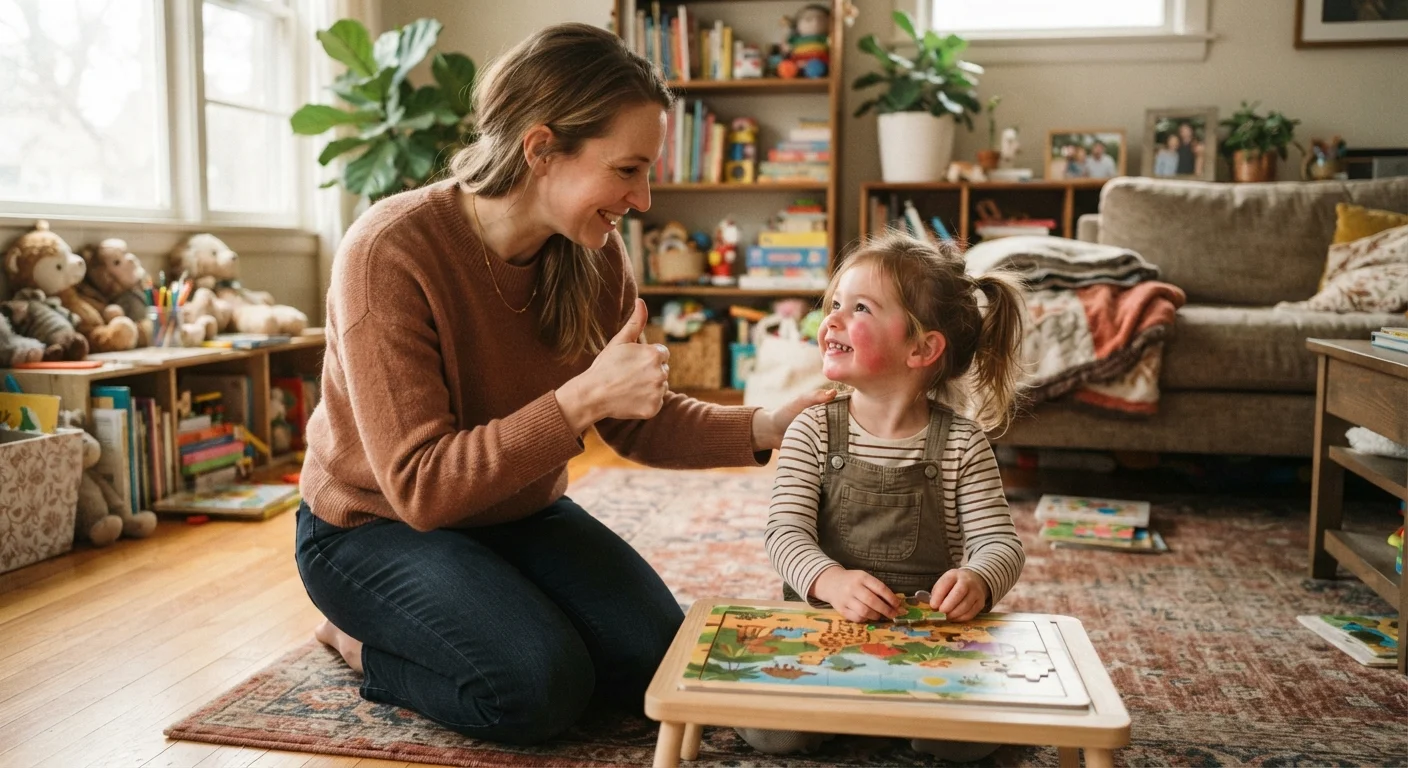
When delivering praise, focus on what a child did rather than who they are. "You worked hard on that puzzle" teaches more than "You're so smart." Behavior-focused feedback gives children clear, actionable information and avoids tying their self-worth to performance outcomes.
Real-World Applications for Families
Positive reinforcement isn't reserved for formal behavior plans. It operates in everyday moments, and parents often use it naturally without naming it as such.
It also integrates well with other approaches. For instance, some parents combine reinforcement with natural consequences - a complementary but distinct strategy. If you're exploring how those tools compare, our piece on natural consequences vs. logical consequences breaks down when each approach fits best.
Positive reinforcement is also frequently discussed within gentle parenting frameworks, though it predates that movement and stands independently on its own evidence base.
Limitations and Honest Caveats
No single strategy works for every child or every situation, and positive reinforcement is no exception. Parents deserve an honest picture.
65%+
Reduction in problem behaviors with PMT
Multiple clinical trials of Parent Management Training programs have reported significant reductions in child conduct problems when reinforcement strategies were applied consistently by caregivers.
3:1
Positive-to-corrective interaction ratio
Child behavior researchers commonly recommend that parents aim for at least three positive interactions for every one corrective interaction to support a cooperative family climate.
One well-documented concern involves over-reliance on tangible rewards. Psychologists sometimes call this the "overjustification effect" - when external rewards are given for activities a child already enjoys intrinsically, motivation for that activity can actually decrease once rewards are removed. This is why experts generally recommend reserving tangible rewards for behaviors that need deliberate shaping, and leaning on social reinforcers like praise and connection as the primary tools.
Positive reinforcement also requires attention and consistency from caregivers - both of which can be difficult under stress or when schedules are unpredictable. Perfection isn't the goal; general reliability over time is what matters most. And for children with significant behavioral or developmental challenges, individualized professional support offers more than any general-purpose article can. Always consult a qualified pediatric behavioral specialist or mental health provider for concerns specific to your child.
This article is for general informational and educational purposes only. It is not a substitute for professional advice from a qualified child psychologist, behavioral specialist, or pediatric healthcare provider.