Why These Conversations Can't Wait
Mental health literacy - the ability to recognize, name, and seek support for emotional struggles - develops gradually across childhood. Research in developmental psychology consistently shows that children whose caregivers talk openly about feelings develop stronger coping skills and are more likely to seek help when they need it as adults.
Yet many parents feel unsure of where to start, worried they'll say the wrong thing or make problems worse. The good news: you don't need professional training to begin. You need consistency, curiosity, and a willingness to keep the door open. Explore the evidence behind these approaches in our piece on raising emotionally resilient kids - what the evidence suggests.
What you will need
Everyday Moments Matter Most
You don't need a formal sit-down conversation to talk about mental health. Car rides, bedtime routines, and cooking dinner together are natural, low-pressure openings. Children often share more when side-by-side rather than face-to-face, so lean into ordinary moments as your most powerful tool.
A Stage-by-Stage Approach
Children at different developmental stages need very different types of conversations. What works beautifully for a five-year-old - simple emotion labels and reassuring physical comfort - will feel patronizing to a fourteen-year-old who craves respect and autonomy. The steps below walk through how to tailor your approach across key developmental windows.
Start With Yourself: Examine Your Own Comfort Level
Before you can talk openly with your child, reflect on how comfortable you are with emotional conversations. Many adults grew up in households where feelings were minimized or kept private. Acknowledge any discomfort - that self-awareness helps you avoid passing the same patterns on.
You don't need to have all the answers. Children benefit far more from a parent who says "I'm not sure, but let's figure it out together" than one who avoids the topic entirely.
Use Age-Appropriate Language for Toddlers and Preschoolers (Ages 2-5)
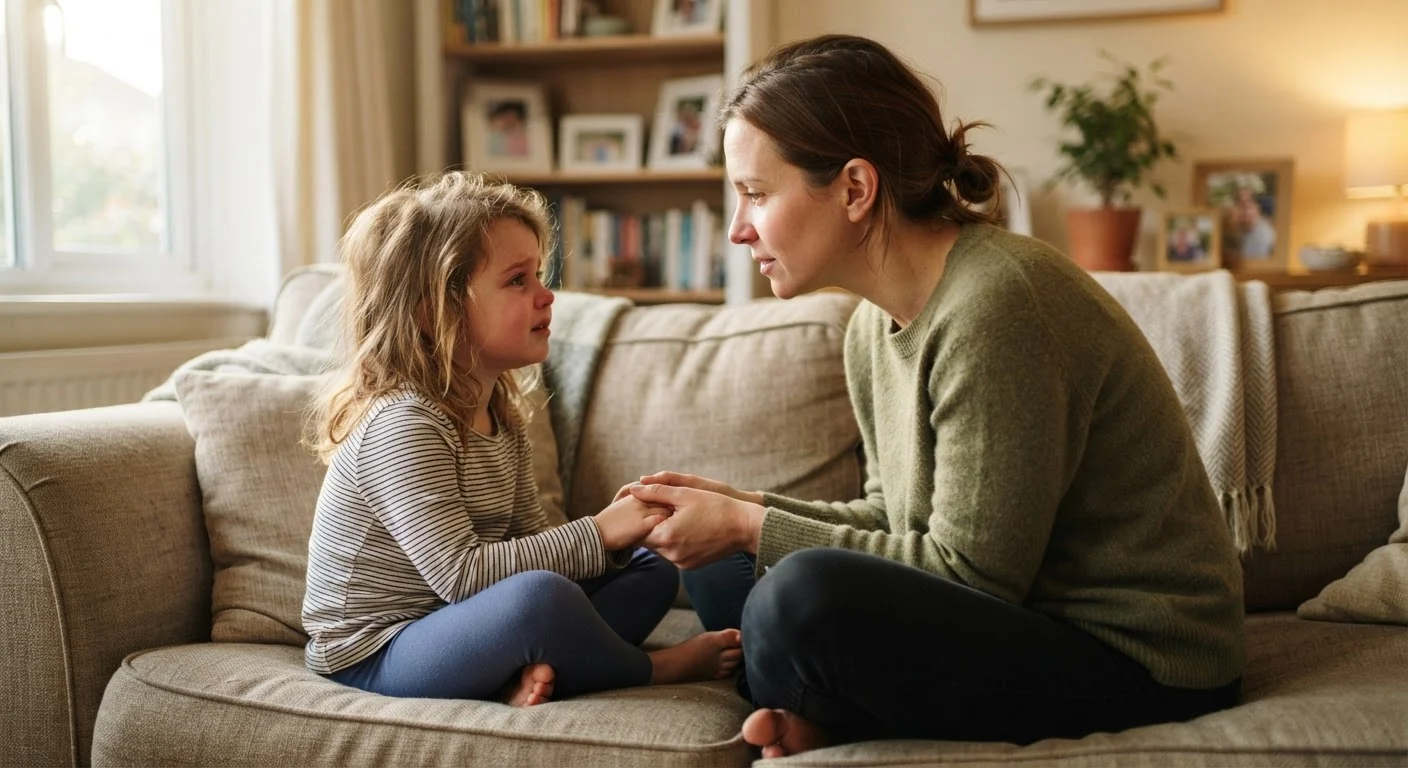
Young children experience big emotions but lack the vocabulary to describe them. Focus on naming feelings simply and directly: "You look frustrated. Is that how you feel?" Use picture books, simple drawings, or emotion cards to make feelings visible and concrete.
Avoid complex explanations. At this stage, the goal is to establish that all feelings are okay to have, and that talking about them is safe. Short, warm exchanges repeated often build the foundation.
Expand the Conversation for School-Age Children (Ages 6-11)
Children in this range can understand that emotions have causes and that people can feel multiple things at once. Introduce the idea that mental health is part of overall health - just like brushing teeth or getting enough sleep.
Use real moments - a tough day at school, a conflict with a friend - as natural entry points. Ask open-ended questions: "What was the hardest part of today?" Resist the urge to immediately fix problems. Listening fully first communicates that their inner world matters. For guidance on related conversations, see our article on talking to children about difficult news and world events.
Navigate Adolescence With Honesty and Respect (Ages 12-18)
Teenagers often resist conversations that feel like lectures or surveillance. Shift toward peer-style dialogue - share your own experiences with stress, uncertainty, or sadness (age-appropriately) to normalize the conversation. Ask for their opinion: "What do you think about how that was handled?"
Respect their autonomy while remaining clearly available. Let them know explicitly: "You don't have to share everything, but I'm always here when you want to talk." Adolescents are more likely to open up when they know there won't be an immediate overreaction or flood of unsolicited advice.
Make Mental Health Part of Regular Family Culture
The most effective mental health conversations aren't single events - they're woven into everyday family life. Establish low-key rituals: a nightly "high, low, and hope" at dinner, or a weekly walk with no screens. These routines reduce the pressure any single conversation carries.
Normalize help-seeking by mentioning therapy or counseling matter-of-factly when relevant - treating it the same way you'd mention seeing a doctor for a physical concern. Families that build this culture support raising emotionally resilient children together over time.
When to Seek Professional Support
If your child shows persistent sadness, withdrawal, sleep changes, loss of appetite, or talks about hopelessness or self-harm, contact a pediatrician or licensed mental health professional promptly. This article is for general informational purposes only and is not a substitute for professional medical or mental health advice. Trust your instincts - earlier support is always better than waiting.
Avoid Dismissing or Minimizing Feelings
Phrases like "you're fine" or "don't worry about it" may feel reassuring, but research in child development consistently shows they can teach children that their emotions aren't safe to share. Instead, acknowledge what your child is feeling before jumping to solutions. Our guide on talking to children about difficult emotions without dismissing them explores this in depth.
Building a Family Culture Around Emotional Openness
Individual conversations matter, but the real impact comes from cumulative family culture. When children grow up in homes where feelings are named without shame, where asking for help is treated as strength, and where parents model their own emotional honesty, they internalize mental health awareness as a normal part of life - not something reserved for crises.
The Mental Wellness hub offers additional practical strategies for everyday emotional health. And if you're looking for a broader framework, our guide on parenting strategies connects these ideas to wider approaches for raising confident, resilient kids.
This article is for general informational and educational purposes only and does not constitute medical or mental health advice. If you have concerns about your child's emotional or mental health, please consult a qualified healthcare or mental health professional.