What Each Product Actually Is
The names can be misleading. Both solid hardwood and engineered wood are real wood products - engineered wood is not laminate or vinyl. The distinction is structural.
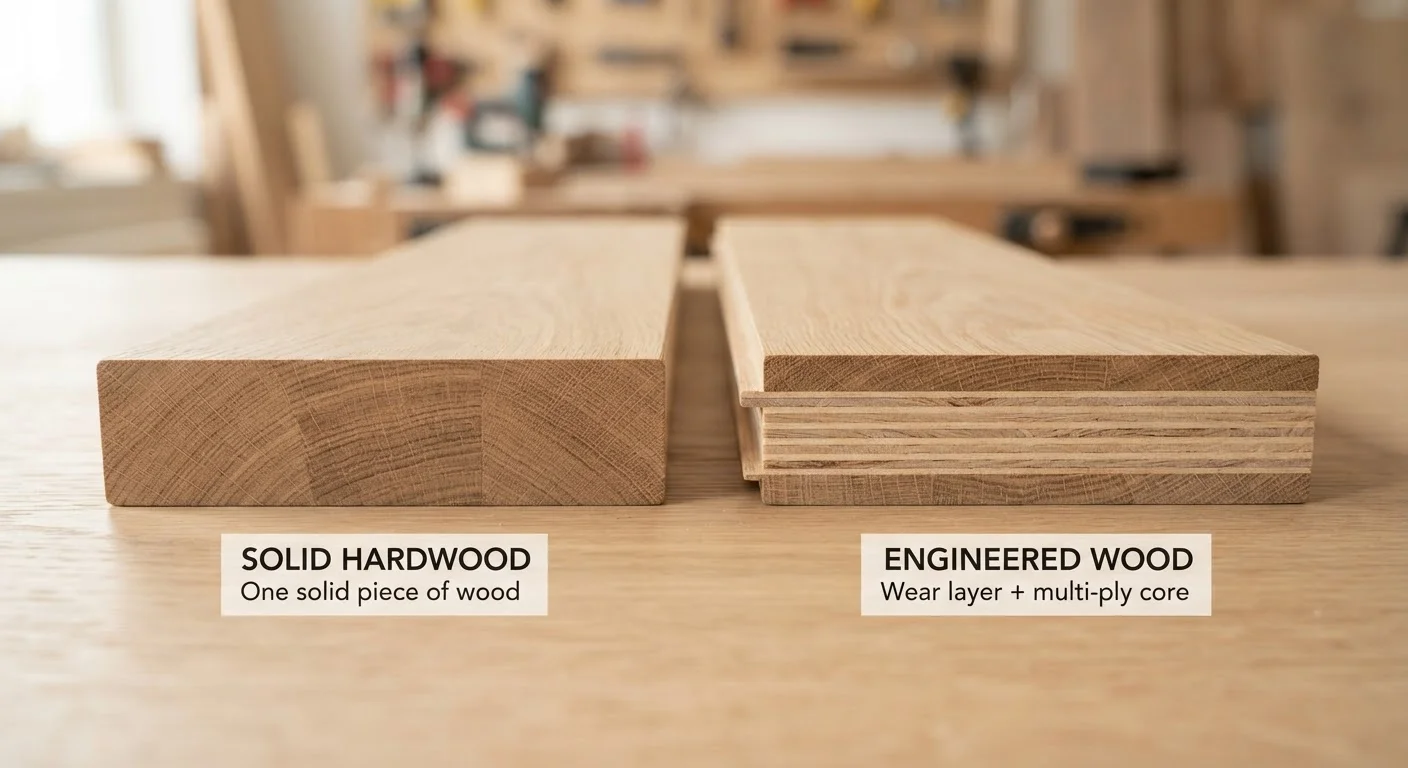
Solid hardwood is exactly what it sounds like: a plank milled from a single piece of timber, typically 3/4 inch thick. Species like oak, maple, hickory, and walnut are common. The consistent wood grain runs through the full depth of the plank.
Engineered wood is constructed from multiple layers bonded together under pressure. The top layer - called the wear layer or veneer - is genuine hardwood, typically 1/12 to 1/6 inch thick. Beneath it are alternating layers of plywood or high-density fiberboard, with each layer's grain oriented perpendicular to the one above. This cross-ply structure is what gives engineered wood its dimensional stability.
After installation, the two products can be visually indistinguishable. The difference only becomes meaningful when conditions in your home start working against the floor.
| Criterion | Solid Hardwood | Engineered Wood |
|---|---|---|
| Construction | Single milled timber plank | Real wood veneer over cross-ply core |
| Typical thickness | 3/4 inch | 3/8 to 3/4 inch |
| Moisture resistance | Low - prone to cupping and warping | Higher - cross-ply reduces movement |
| Refinishing potential | 4-6 times over its life | 0-2 times, depending on veneer thickness |
| Installation methods | Nail or staple only | Nail, staple, glue, or float |
| Suitable installation levels | Above grade only | Above, on, or below grade |
| Radiant heat compatible | Generally not recommended | Yes, with compatible products |
| Expected lifespan | 80-100+ years with refinishing | 25-50 years depending on veneer |
How Moisture and Temperature Affect Each Option
Wood is a hygroscopic material - it absorbs and releases moisture from the air, expanding when humidity rises and contracting when it falls. This is the central practical difference between the two flooring types.
Solid hardwood is especially sensitive to this movement. In rooms with consistent humidity (typically between 35% and 55% relative humidity), solid floors perform beautifully for generations. But in kitchens, bathrooms, basements, or climates with dramatic seasonal swings, that constant movement leads to cupping, gapping, or buckling.
Engineered wood's cross-ply construction counteracts this tendency. Because adjacent layers are oriented in opposite directions, the forces of expansion pull against each other rather than accumulating. The result is a floor that moves significantly less under the same conditions.
18-25mm
Typical expansion per 2.4m width of solid hardwood
Wood flooring industry guidelines estimate solid hardwood can expand or contract this amount across a room-width installation as seasonal humidity shifts.
1/12"-1/6"
Engineered wood veneer thickness range
The thickness of the real wood wear layer in engineered flooring directly determines how many times, if any, the floor can be sanded and refinished.
35%-55%
Recommended indoor relative humidity for wood floors
The National Wood Flooring Association (NWFA) recommends maintaining indoor humidity within this range year-round to minimize wood movement in both solid and engineered floors.
This structural advantage makes engineered wood the appropriate choice for on-grade or below-grade installations, rooms over unconditioned crawl spaces, and homes with radiant heat systems. Solid hardwood is generally not recommended for these scenarios, and most manufacturers' warranties reflect that restriction.
Refinishing, Lifespan, and Long-Term Maintenance
One of solid hardwood's most significant advantages is refinishability. Because the plank is solid throughout, a flooring professional can sand away surface scratches, stains, and worn finish and apply a fresh coat - typically four to six times over the floor's life. This means a well-maintained solid hardwood floor can last 80 to 100 years or more.
Engineered wood's refinishability depends entirely on the thickness of the veneer layer. Thicker veneer (3 mm or more) may allow one or two sandings. Thinner veneers - common in lower-cost engineered products - cannot be refinished at all without sanding through to the core. When shopping for engineered wood, the wear layer thickness is a meaningful quality indicator worth examining closely.
For routine maintenance, both floors require similar care: regular sweeping or dry mopping, prompt cleanup of spills, and humidity management. Avoid wet mopping either type. Area rugs and furniture pads reduce wear in high-traffic zones regardless of which floor you choose.
A Note on Acclimation for Both Floor Types
Before installation, wood flooring should be stored inside the home - in the room where it will be installed - to allow it to reach equilibrium with the local temperature and humidity. For solid hardwood, manufacturers typically recommend three to seven days; for engineered wood, at least 48 hours is common. Skipping acclimation increases the risk of post-installation gaps or buckling. Always follow the specific manufacturer's guidance for the product you've chosen.
Installation Considerations and Where Each Floor Can Go
Installation method and location eligibility are practical factors that often settle the decision before aesthetics even enter the conversation.
Solid hardwood must be nailed or stapled to a wood subfloor. It cannot be glued directly to concrete, and it is not suitable for below-grade rooms. It also requires an acclimation period - typically three to seven days - for the planks to adjust to the home's ambient humidity before installation.
Engineered wood offers more flexibility. It can be nailed, stapled, glued, or floated (installed without adhesive or fasteners) depending on the product and subfloor type. It can go directly over concrete slabs, making it viable for basements and main-floor open-plan layouts built on slab foundations. Acclimation is still recommended but typically shorter.
Both options require a flat, structurally sound subfloor. Variations of more than 3/16 inch over 10 feet should be corrected before either floor goes down. If you're unsure about subfloor condition or whether a specific product is appropriate for your installation scenario, consulting a licensed flooring installer is worthwhile before purchasing materials.