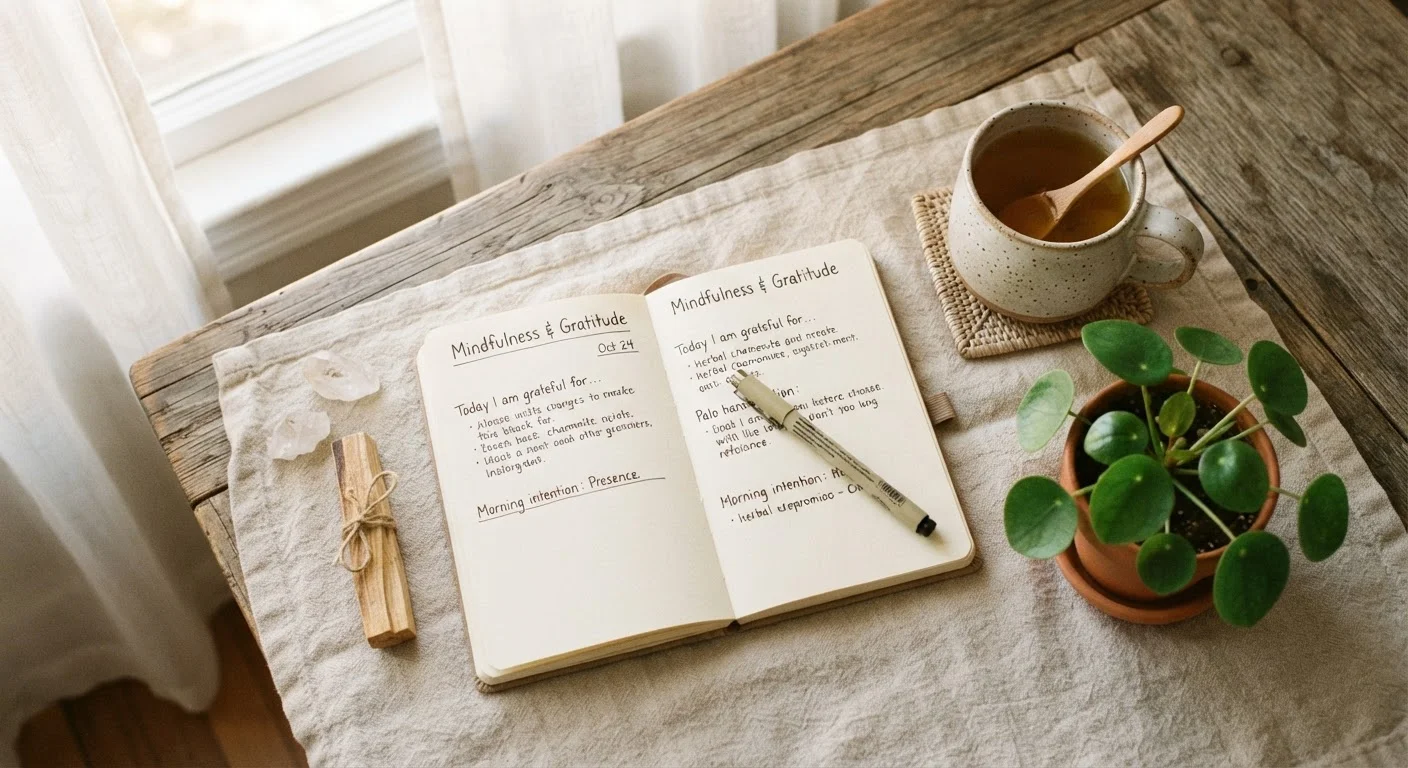

Why Journaling Works for Emotional Clarity
The core value of journaling isn't literary - it's cognitive. When thoughts stay inside your head, they loop. Writing them down forces a kind of external processing: you move from experiencing a feeling to observing it. That shift alone can reduce its intensity.
Research in psychology has consistently linked expressive writing to improvements in mood and stress regulation. The act of translating an emotion into words - what some researchers call affect labeling - appears to engage the prefrontal cortex, the part of the brain associated with reasoning and self-regulation. In plain terms: naming what you feel helps you manage it.
This doesn't require deep psychological insight or hours of reflection. Even a brief, honest account of what happened and how you responded can create enough distance to see a situation more clearly. That clarity is particularly useful when you're feeling overwhelmed, stuck in a decision, or unable to identify why something is bothering you.
Journaling also builds a personal record over time. Patterns that are invisible in the moment - recurring stressors, emotional triggers, times of day when anxiety spikes - become visible across entries. That self-knowledge is difficult to develop any other way.
Expressive writing
Writing that focuses on personal thoughts and feelings rather than facts or tasks. Research suggests it can help reduce stress and improve emotional processing.
Affect labeling
The act of putting feelings into words. Studies suggest this process can reduce the emotional intensity of an experience by engaging the brain's reasoning centers.
Free writing
A journaling method where you write continuously for a set time without stopping to edit or judge what comes out. The goal is to surface thoughts without filtering them.
Emotional vocabulary
The range of words a person can use to describe their feelings. A broader emotional vocabulary is associated with better self-awareness and emotional regulation.
Habit anchoring
Attaching a new behavior to an existing, automatic routine - like pairing journaling with your morning coffee - to make the new habit easier to maintain.
Common Barriers - and Why They Don't Have to Stop You
Most people who haven't journaled consistently cite the same handful of objections: I don't know what to write, I'm not a good writer, I don't have time, I tried before and stopped. These are understandable - but none of them are actually disqualifying.
Journaling has no grammar requirements and no audience. Nobody grades it. You're not writing for posterity; you're writing to think. The moment you stop treating it as a writing exercise and start treating it as a thinking tool, the barrier drops significantly.
The "I don't have time" concern usually means the habit doesn't have a clear home in the day. Five minutes before bed or right after waking requires almost no time investment. If you're building other morning habits, consider reading how others structure a morning routine around mental clarity to find a natural slot.
Journaling is not a clinical intervention
While journaling can support emotional awareness and stress management, it is not a replacement for therapy or psychiatric care. If you're experiencing persistent anxiety, depression, trauma responses, or other mental health concerns, please reach out to a licensed mental health professional. Journaling is a complement to professional support - not a substitute for it.
For people who've tried journaling before and quit: stopping isn't failure. Habits take time to embed. Picking it back up - even months later - is completely valid. You don't lose credit for previous entries.
Simple Approaches to Get Started
There's no single correct method. The approach that helps you process emotions is the right one. Here are a few low-barrier starting points:
- Free writing: Set a timer for five minutes and write continuously without stopping to edit or judge. It doesn't need to be coherent. The goal is to keep the pen moving and let thoughts surface.
- Single-question prompts: Ask yourself one question and respond to it. Good starting prompts include: What am I feeling right now and where do I notice it in my body? What conversation am I avoiding? What did today ask of me?
- The daily download: Write a brief, factual account of what happened during your day, then add one sentence about how you actually felt about it. Separating event from emotion builds emotional vocabulary over time.
- Unsent letters: Write directly to a person, situation, or version of yourself - with no intention of sending it. This format often unlocks things that feel too charged to write in a neutral third-person style.
Journaling works well alongside other solo mental wellness habits. It's worth understanding what solo practices and social support each offer so you can use both in a complementary way.
Keep the barrier as low as possible
Your journal doesn't have to be a beautiful notebook - a notes app, a plain notepad, or even a folded piece of paper works just as well. The format that removes friction is the one that will actually get used. Don't let the search for the perfect tool delay starting.
Making It a Habit Without Forcing It
Sustainability is what separates a useful journaling practice from a guilt-inducing one. The habits most likely to last are the ones with the fewest friction points. That means keeping your journal accessible, choosing a format you actually enjoy, and releasing the idea that skipping a day is a setback.
Attaching journaling to an existing anchor - morning coffee, a lunch break, the few minutes before sleep - tends to work better than carving out dedicated new time. Habit research consistently shows that pairing a new behavior with a well-established one increases adherence.
Keep entries short by default. One paragraph is enough. Longer sessions can happen when you have more to work through, but a minimum viable entry prevents the habit from feeling like a burden on low-energy days.
If you want to place journaling within a broader self-care structure, the guide to building a personal mental wellness routine covers how to layer habits sustainably without overwhelming yourself.
Finally, remember that journaling is one tool among many. It excels at processing internal experience, but it works best alongside - not instead of - genuine human connection and, when needed, professional support.
This article is for general informational and educational purposes only and is not a substitute for professional mental health advice, diagnosis, or treatment. If you are experiencing significant emotional distress, please consult a qualified mental health professional.