
Why a Multi-Age Household Routine Is Worth the Effort
Running a home with children at multiple developmental stages can feel like managing three different households at once. A toddler's need for nap-anchored predictability collides with a school-age child's homework demands and a teenager's bid for independence. Yet research in child development consistently shows that predictable daily routines - even loosely structured ones - support children's emotional regulation, reduce anxiety, and improve behavior across age groups. As explored in the role of routine in a child's sense of security, predictability helps children build an internalized sense of order that pays dividends well into adulthood.
The challenge isn't whether routines matter - it's designing one flexible enough to serve everyone. The approach that works is not a rigid minute-by-minute schedule but a layered structure built around shared anchor points, with age-appropriate expectations nested within each one.
Routines Are Not One-Size-Fits-All
Every child's developmental needs, temperament, and family context are different. The strategies here are general guidance, not prescriptions. If your child is struggling significantly with transitions, sleep, or behavior despite a stable routine, consult your pediatrician or a child development specialist for personalized support.
This guide walks you through a practical, step-by-step process for building that kind of routine - starting with an honest look at where your family actually is right now, rather than where you think you should be.
What You'll Need Before You Start
Building an effective routine requires minimal materials but does require honest observation and a collaborative mindset. Gather your tools, then set aside a dedicated time - ideally without the kids present initially - to map out the framework before involving them in the details.
What you will need
Visual Schedule Board
Helps toddlers and early elementary children follow routine steps independently using pictures or icons.
Shared Family Calendar (digital or paper)
Keeps school-age kids and teens aware of weekly commitments and routine expectations.
Timers or Clock Displays
Helps younger children understand time transitions without constant parental reminders.
Routine Checklist Cards
Gives school-age children a tangible checklist to manage morning or bedtime tasks independently.
Once you have these basics in place, you're ready to work through the steps below. Remember that the goal is a routine sustainable for real life, not a perfect system that collapses under pressure. For ideas on how small, consistent practices compound over time, see how small family habits create big shifts.
Step-by-Step: Building Your Household Routine
Work through these steps in order. Each one builds on the last, and skipping ahead - particularly to the visual tools before you've mapped the structure - often leads to a routine that looks good on paper but doesn't survive a real week.
Use Anchor Points, Not Minute-by-Minute Plans
Rather than scripting every hour, identify three to five non-negotiable anchor points in your day - wake-up, meals, homework time, and bedtime. Clustering tasks around these anchors gives structure without rigidity, making your routine far easier to maintain over time.
Map Your Family's Existing Schedule
Before building anything new, observe what already happens. For one week, note when your family naturally wakes, eats, leaves the house, does homework, and winds down. Identify where friction consistently occurs - the morning rush, the after-school crash, the bedtime battle. These pressure points are exactly where a routine can help most.
Identify Each Child's Developmental Needs
Children at different stages need different things from a routine. Toddlers (ages 2-4) thrive on repetition and visual cues - they can't yet read a clock but can recognize the sequence of brush teeth, then story, then sleep. School-age children (5-12) benefit from growing autonomy within clear expectations, such as managing their own checklist. Teens need room to negotiate and take ownership, though consistent anchor points like family dinners still matter enormously for connection.
Understanding where each child is developmentally - not just by age but by temperament - shapes how you design each layer of your routine. For deeper context, explore child development milestones and strategies.
Design a Layered Routine Around Anchor Points
Choose three to five daily anchor points that apply to every family member: a consistent wake time, a shared meal, an after-school or after-work transition window, and a bedtime sequence. Then layer age-specific tasks around each anchor. For example, the after-school anchor might mean snack and quiet play for a preschooler, homework block for a third grader, and self-directed wind-down for a teenager - all happening simultaneously under one shared rhythm.
This layered approach means you're running one household routine, not three separate ones. For guidance on building in healthy sleep, nutrition, and movement, see how to design a family routine that supports sleep, nutrition, and movement.
Create Age-Appropriate Visual or Written Supports
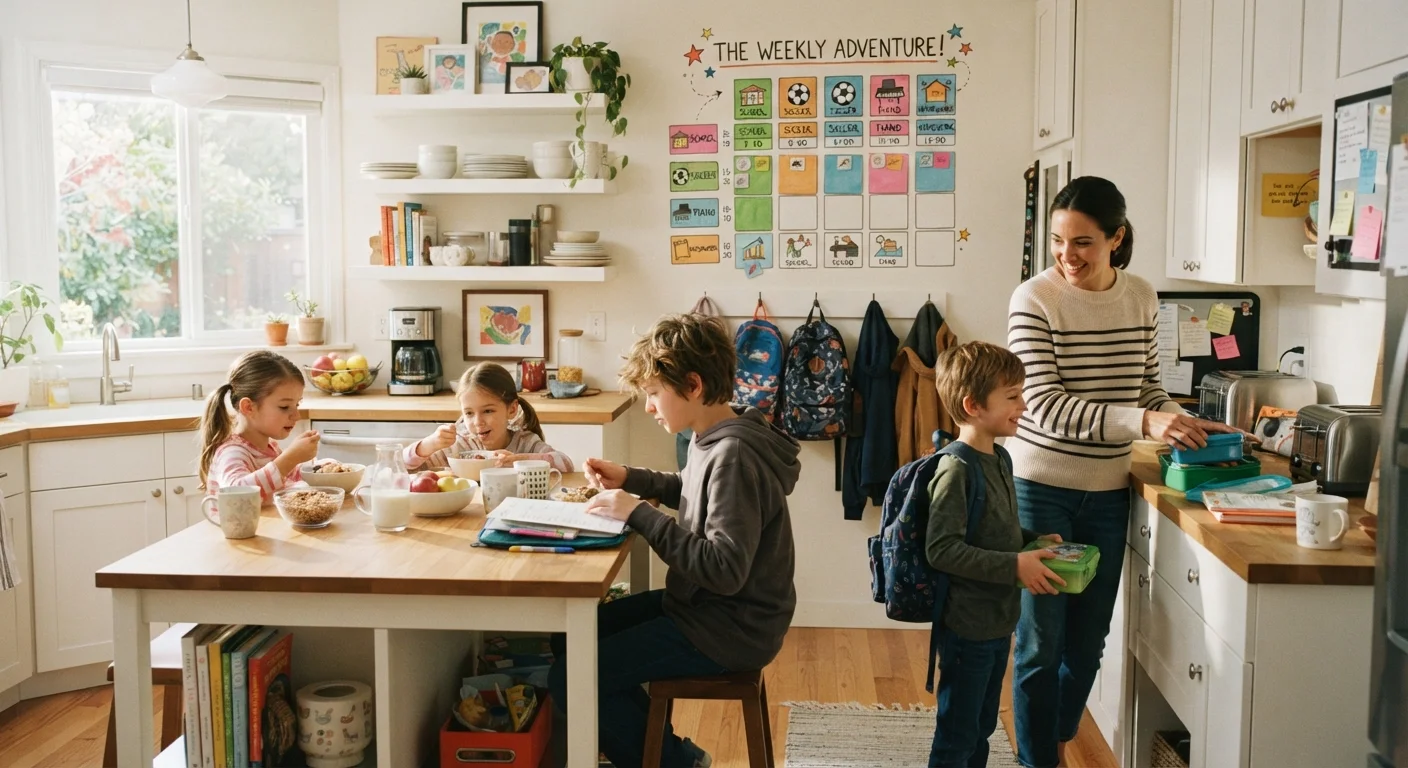
For toddlers and preschoolers, post a picture-based schedule at their eye level showing the sequence of daily events. For elementary-age children, a simple checklist they can check off themselves builds independence and reduces nagging. Teens generally prefer a shared digital calendar over a posted chart - give them access and responsibility for updating it. The goal is for children to internalize the routine over time, not remain dependent on constant parental reminders.
Introduce the Routine Gradually and Collaboratively
Roll out changes over one to two weeks rather than overhauling everything at once. Start with your most problematic pressure point - typically mornings or bedtime. Hold a brief family meeting appropriate to your children's ages: even a three-year-old can participate in choosing which stuffed animal goes in their bedtime routine. Framing the routine as something the family builds together, rather than rules handed down, reduces resistance significantly.
Build In Flexibility and Plan for Transitions
Life disrupts routines - school breaks, illness, travel, and seasonal shifts all require adaptation. Build a "flex window" into each day (an unscheduled 20-30 minutes) that absorbs the unexpected without unraveling the whole structure. Revisit and adjust your routine at natural transition points: the start of a new school year, after a new sibling arrives, or when a child enters a new developmental stage. For seasonal adjustments, seasonal family wellness strategies can help you adapt with intention.
Evaluate and Refine Every Few Weeks
A routine that works in October may not serve your family well in March. Check in briefly every three to four weeks: What's running smoothly? Where is friction creeping back in? Ask children what feels hard or unfair. Small refinements - shifting bedtime by 15 minutes, swapping chore assignments - maintain relevance without requiring a full rebuild. Routines are living structures, not permanent rules.
Sustaining the Routine as Children Grow
One of the most common reasons household routines fall apart isn't lack of effort - it's that the structure stops fitting the children it was built for. A morning routine that worked beautifully when your child was seven may feel suffocating and infantilizing at eleven. Plan to revisit the routine substantively at each major developmental transition, not just when friction appears.
As children grow, the goal shifts from structure you provide to structure they internalize. A teenager who can manage their own morning, homework window, and sleep schedule - even imperfectly - is developing exactly the executive function skills that will serve them in adulthood. Your role gradually moves from architect to consultant. For more on shaping the home environment to support that growth, explore how to build a home environment that supports learning and curiosity.
Avoid Over-Scheduling Your Children
A packed schedule can create as much stress as no schedule at all. Research in child development consistently points to the value of unstructured play and downtime. Build breathing room into your routine intentionally - it supports creativity and emotional recovery. See what research says about balancing structured and unstructured time for more guidance.
This article is for general informational and educational purposes only. It is not a substitute for professional advice from a pediatrician, child psychologist, or family therapist. If your child is experiencing significant behavioral, emotional, or developmental challenges, please consult a qualified professional.