
Why Balance Matters More Than Intensity
Most people think about exercise in terms of how hard they push themselves. But the more useful question is whether their weekly movement covers all the things the body actually needs: cardiovascular endurance, muscular strength, joint mobility, and recovery time.
A routine that includes only running, only lifting, or only yoga leaves real gaps. Over time, those gaps show up as plateaus, nagging injuries, or the kind of burnout that causes people to abandon fitness habits entirely. Balance isn't a compromise - it's what makes a routine sustainable for years, not just weeks.
If you're returning to structured movement after a break, see our guide on returning to exercise after a long break for pacing guidance specific to that situation.
“Exercise is the single best thing you can do for your brain in terms of mood, memory, and learning. Even 20 minutes of physical activity has measurable effects.”
— John Ratey, Associate Clinical Professor of Psychiatry, Harvard Medical School, and author of 'Spark'
The Four Pillars of a Complete Routine
A genuinely well-rounded week of movement draws from four categories, each serving a distinct purpose:
1. Cardiovascular Exercise
Cardio strengthens the heart, improves circulation, supports weight management, and enhances mood. Moderate-intensity options include brisk walking, cycling, swimming, or dancing. Vigorous options include jogging, aerobic classes, or competitive sports. Aim for variety to reduce repetitive strain.
Vigorous Activity Counts Double
The federal guidelines use a simple equivalency: one minute of vigorous-intensity activity (such as running or cycling hard) counts as two minutes of moderate-intensity activity (such as brisk walking). This means a 75-minute weekly running program can meet the same aerobic benchmark as 150 minutes of walking.
2. Strength Training
Resistance work - using bodyweights, free weights, machines, or resistance bands - builds and maintains muscle mass, supports bone density, and improves resting metabolism. Two sessions per week covering all major muscle groups (legs, back, chest, shoulders, core) meets the federal minimum. If you prefer training at home, our home workout routine guide covers effective bodyweight options.
3. Flexibility and Mobility
Stretching, yoga, and mobility drills maintain range of motion, reduce muscle tightness, and lower injury risk - particularly important as we age. Even 10 minutes of deliberate flexibility work several times per week delivers measurable benefit.
4. Rest and Recovery
Muscle repair, hormonal regulation, and neurological adaptation all happen during rest, not during exercise itself. Rest is not wasted time - it is when the body converts effort into fitness.
150 min
Recommended weekly moderate cardio for adults
Per the U.S. Department of Health and Human Services Physical Activity Guidelines for Americans.
2x/week
Minimum strength training sessions recommended
The same federal guidelines call for muscle-strengthening activity on at least two days per week.
~80%
Adults not meeting aerobic activity guidelines
CDC estimates that roughly 4 in 5 American adults do not meet both aerobic and muscle-strengthening recommendations.
What a Sample Week Could Look Like
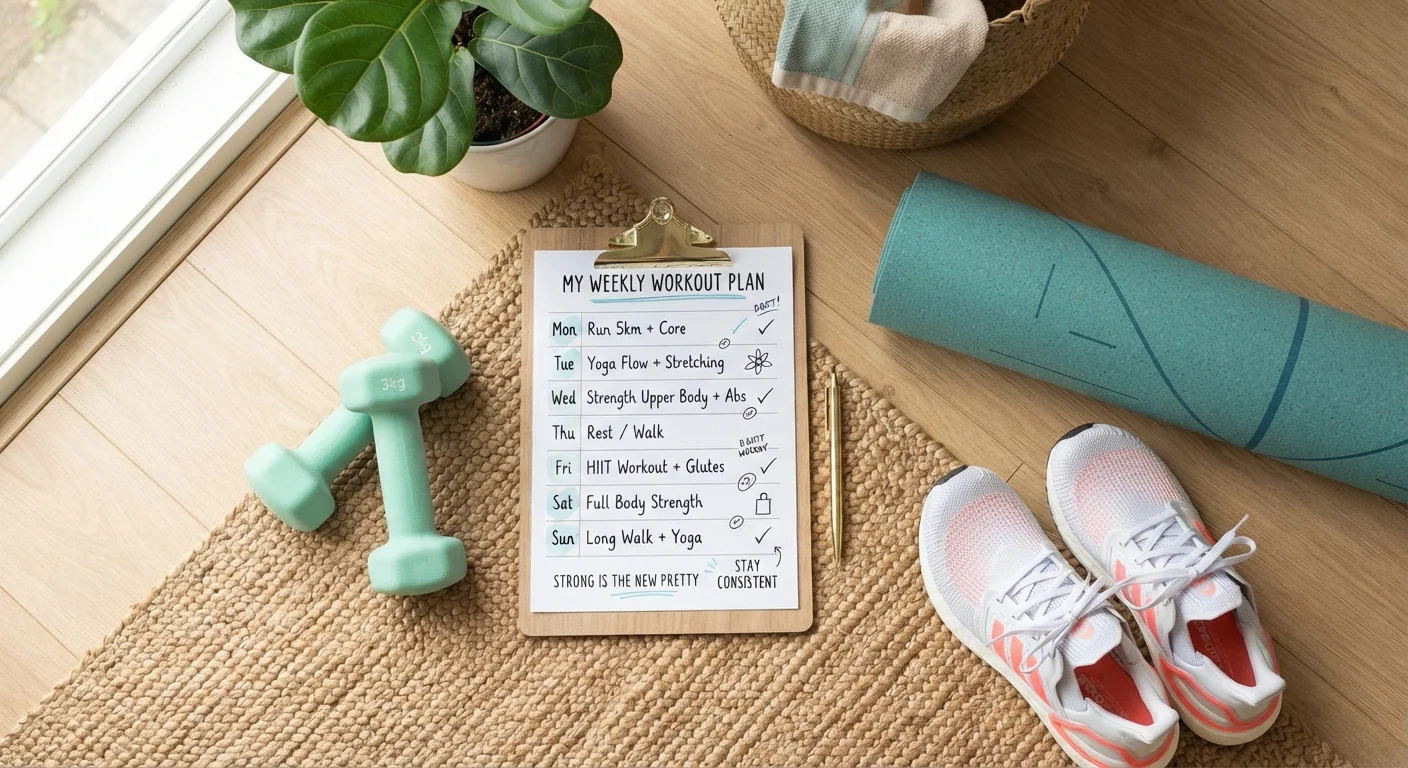
Below is a general framework illustrating how one week might be structured. This is not a prescription - it is an illustration of how the four pillars can fit into seven days for a moderately active adult.
| Day | Focus | Example Activity |
|---|---|---|
| Monday | Strength | Full-body resistance training, 30-40 min |
| Tuesday | Cardio | Brisk walk or bike ride, 30-45 min |
| Wednesday | Flexibility / Active recovery | Yoga or dynamic stretching, 20-30 min |
| Thursday | Strength | Upper or lower body focus, 30-40 min |
| Friday | Cardio | Jog, swim, or aerobic class, 30 min |
| Saturday | Active recreation | Hiking, recreational sport, or long walk |
| Sunday | Rest | Light movement or full rest |
Make Rest Days Active, Not Idle
Rest days don't have to mean lying on the couch. Light walking, gentle stretching, or casual yard work still support recovery while keeping your body moving. This kind of low-intensity daily movement - sometimes called NEAT - contributes meaningfully to overall health on its own terms.
This framework easily adapts - three days per week can still hit the core benchmarks if sessions are structured thoughtfully.
Schedule your workouts the same way you schedule meetings - put them on the calendar with a specific time and type, not just 'exercise.' Vague intentions rarely survive a busy week.
Research on habit formation consistently shows that implementation intentions (specific when-where-how plans) dramatically increase follow-through compared to general goals.
If you have only 20 minutes on a hectic day, do something - a short walk, a brief bodyweight circuit. Protecting the habit matters more than hitting a perfect duration every session.
Behavioral science shows that maintaining the routine pattern during low-capacity periods prevents the all-or-nothing drop-off that derails most fitness efforts.
Adapting the Framework to Your Life
The best routine is one you can actually follow consistently. A few principles help translate the framework into your real schedule:
- Start with what fits. If three days is sustainable right now, build there before reaching for five. Gradually increasing volume over weeks is safer and more effective than starting at maximum effort.
- Stack movement with existing habits. A 15-minute walk after lunch, stretching before bed, and a strength session on Saturday can collectively meet weekly targets without a gym membership or large time blocks.
- Support exercise with nutrition. Physical activity and eating habits reinforce each other. Our weekly meal planning guide walks through how to align nutrition with activity goals in a practical way.
- Consider the whole family. Movement habits often stick better when they're social. Resources on family wellness can help integrate activity across different ages and schedules.
Exercise also has a well-documented relationship with mental wellbeing. If you're building wellness habits more broadly, our overview of building a personal mental wellness routine covers how physical and mental health practices complement each other.
Common Pitfalls to Avoid
Even well-intentioned routines run into predictable obstacles. Recognizing these patterns early makes it easier to course-correct:
More Is Not Always Better
Training hard every single day without adequate recovery can lead to overtraining syndrome, characterized by fatigue, declining performance, and increased injury risk. Most adults benefit from one to two true rest or low-intensity days per week. Pushing through persistent soreness or fatigue is a warning sign, not a badge of effort.
- Skipping flexibility entirely. It's usually the first category cut when time is short, but consistent neglect leads to mobility losses that make other exercise harder and riskier over time.
- Treating rest as failure. Missing a session often triggers an all-or-nothing mindset. One skipped workout does not undermine progress - abandoning the habit does.
- Ignoring daily movement outside formal exercise. Structured workouts are only part of the picture. Non-exercise activity throughout the day - walking, standing, household tasks - plays a larger role in overall health than most people realize.
- Chasing novelty over consistency. Switching programs constantly prevents the progressive adaptation that produces results. Give any routine at least four to six weeks before evaluating whether to change it.
Talk to a Professional Before Starting
This article provides general educational information, not personalized medical or fitness advice. If you have a chronic health condition, have been inactive for an extended period, or experience pain during exercise, consult a qualified healthcare provider or certified fitness professional before changing your activity level. This is especially important for older adults and those managing cardiovascular, orthopedic, or metabolic conditions.
This article is for general informational purposes only and does not constitute medical or fitness advice. Always consult a qualified healthcare professional before beginning or significantly changing an exercise program, particularly if you have any health conditions or concerns.