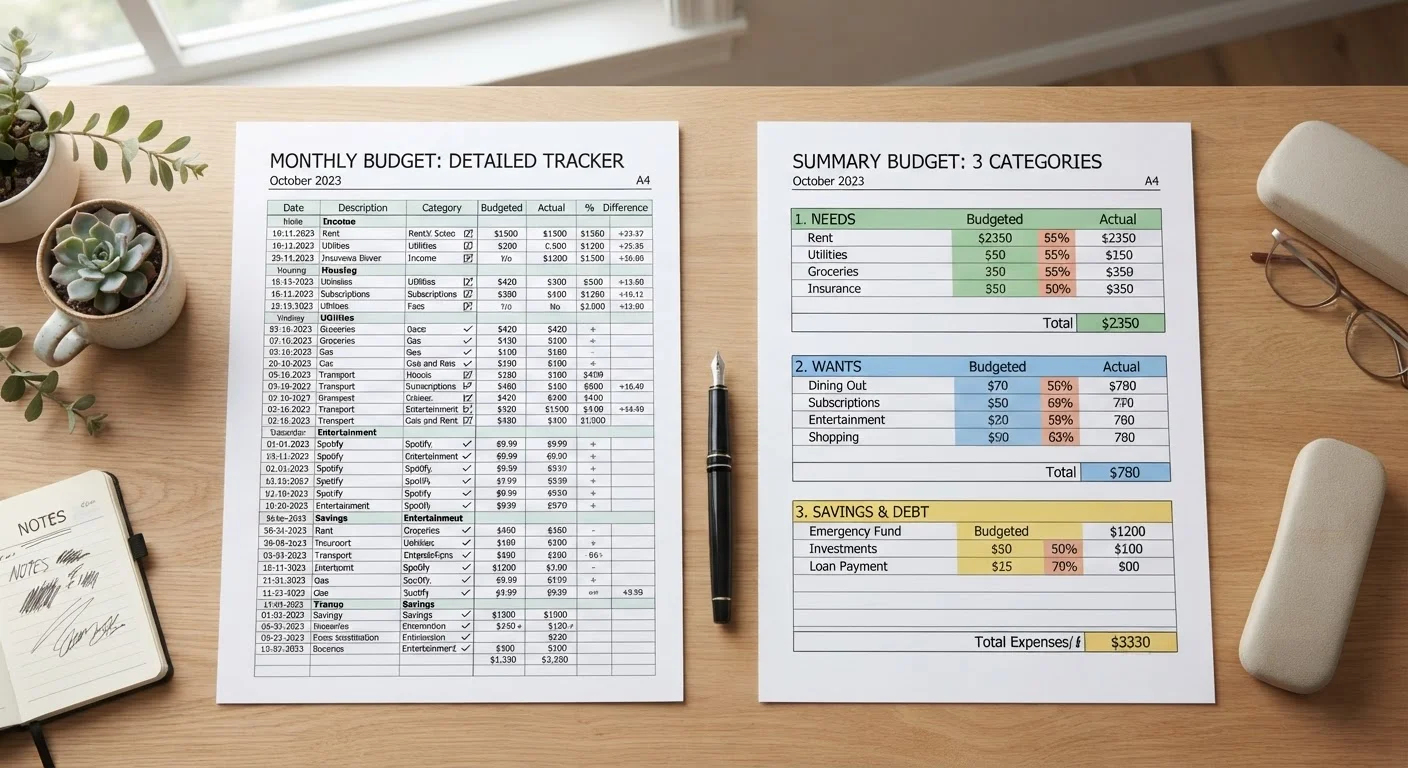

How the Three Buckets Work
The 50/30/20 rule organizes every dollar of your after-tax income into three broad categories. Here is what each one covers:
- 50% - Needs: Essential expenses you must pay to maintain basic living - rent or mortgage, utilities, groceries, insurance premiums, minimum loan payments, and basic transportation costs.
- 30% - Wants: Discretionary spending that improves your life but is not strictly necessary - dining out, streaming services, gym memberships, vacations, and hobbies.
- 20% - Savings & Debt Repayment: Money directed toward your financial future - an emergency fund, retirement contributions, and extra debt payments beyond the required minimums.
For example, if your monthly take-home pay is $4,000, the framework suggests $2,000 for needs, $1,200 for wants, and $800 for savings and debt. The power lies in simplicity: you are not building a spreadsheet with 40 categories. You are making a decision about which bucket each expense belongs to. For a deeper look at how to draw the line between needs and wants, that judgment alone can reshape your budget.
57%
Americans living paycheck to paycheck
A 2023 LendingClub report found that roughly 57% of American consumers describe themselves as living paycheck to paycheck, underscoring the need for structured budgeting frameworks.
20%
Recommended savings and debt repayment rate
The 50/30/20 framework designates 20% of after-tax income for savings and debt repayment - a benchmark broadly aligned with guidance from financial literacy organizations including the CFPB.
36%
Adults without a three-month emergency fund
According to Federal Reserve survey data, a significant share of U.S. adults lack sufficient savings to cover three months of expenses - the kind of cushion the 20% savings bucket is designed to build over time.
Why Small, Consistent Allocation Beats Occasional Discipline
The 50/30/20 rule works not because it is perfect, but because it is repeatable. Rather than requiring willpower every time you face a spending decision, it creates a standing structure your money flows into automatically each month.
When you set up automatic transfers - sending 20% to savings the day your paycheck arrives - you remove the decision entirely. Behavioral economics research consistently shows that automating financial decisions reduces the likelihood of deviation. The "pay yourself first" principle embedded in the 20% savings bucket is one of the most well-supported ideas in personal finance.
This consistency is what turns the framework into real progress. A person saving $400 per month for five years accumulates $24,000 before any investment growth is considered - simply by following a standing rule. Habits that sustain budgeting matter more than any single month of perfect spending.
Automate Your 20% on Payday
Set up an automatic transfer to your savings account for the same day your paycheck deposits. When savings move before you can spend them, the 20% allocation becomes effortless. Even starting with a smaller percentage and increasing it gradually is more effective than relying on whatever is left at month's end.
Adjusting the Framework to Fit Your Life
The 50/30/20 split is a starting point, not a mandate. Several real-world situations call for deliberate adjustments:
- High cost-of-living areas: If rent alone consumes 40% of take-home pay, your needs bucket will naturally run over 50%. In that case, trimming the wants category first - rather than cutting savings - is generally the more sustainable approach.
- High-interest debt: If you carry credit card balances at high interest rates, temporarily shifting more of the 30% wants budget toward debt repayment can save significantly on interest over time.
- Early career savers: Someone just starting out may not yet be able to save 20%. Beginning at 10% and increasing by 1-2% annually is a legitimate pathway to the target.
The 50/30/20 rule is one of several structured approaches worth knowing. If you want to see how it compares to envelope budgeting, zero-based budgeting, and pay-yourself-first methods, the budgeting method comparison lays out the trade-offs clearly. And for ongoing guidance on building savings habits alongside debt management, the Saving & Debt hub covers both in practical depth.
This article is for general informational and educational purposes only. It is not personalized financial advice. Consult a qualified financial professional for guidance specific to your situation.