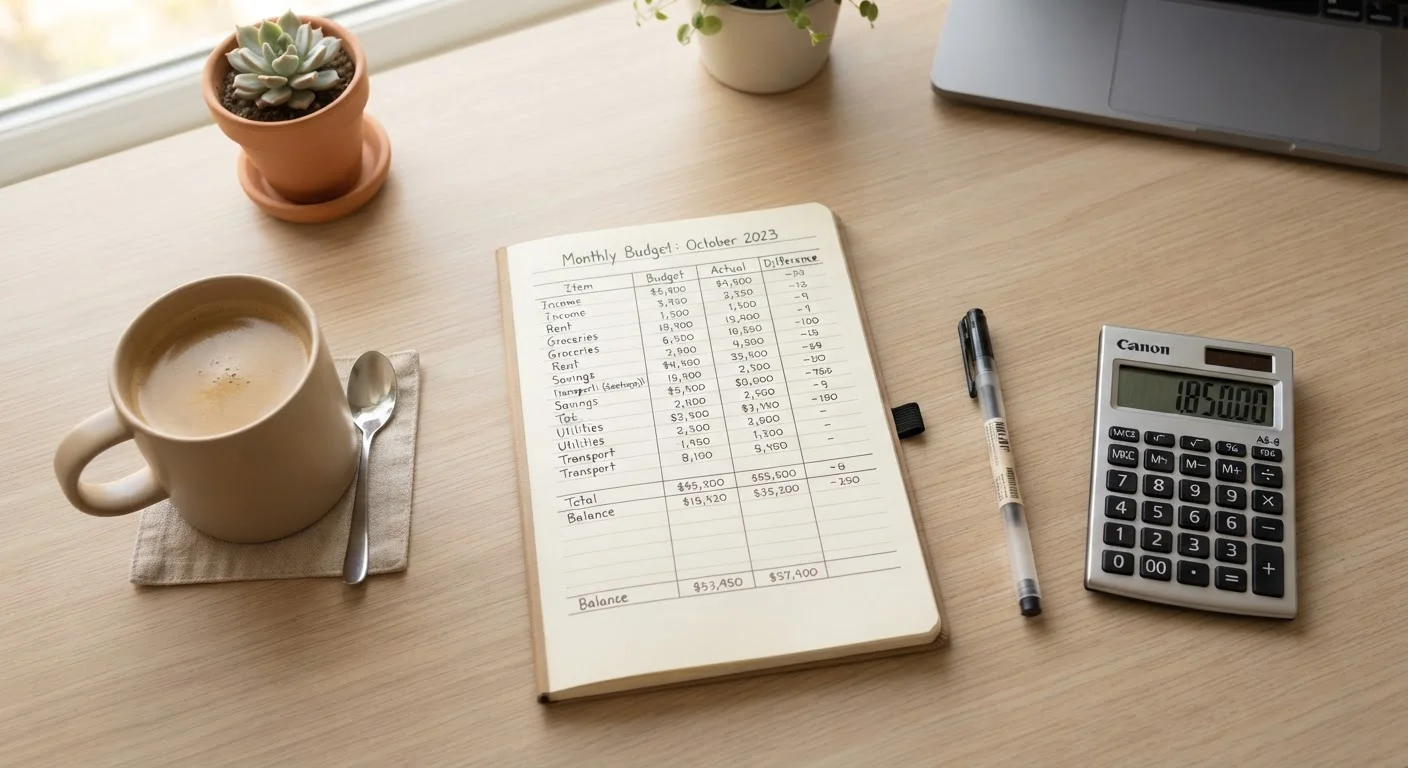

Why Budgeting Is a Behavior Problem, Not a Math Problem
Most people who struggle with budgets aren't failing at arithmetic. They're failing at consistency - and that's a fundamentally different problem. A budget is only useful if it's used repeatedly, adjusted honestly, and structured in a way that reduces friction over time.
Research from behavioral economics consistently shows that people make better financial decisions when those decisions are simplified, automated, or tied to existing routines. Understanding the behavioral gap is the first step. If you've tried and abandoned budgets before, our guide on why budgets fail can help identify what broke down and why.
The habits outlined below aren't about perfection. They're about building a system that makes the right financial choices easier to make consistently.
The Core Habits That Make Budgets Stick
After reviewing how sustained budgeters behave versus those who abandon plans quickly, a clear set of habits emerges. These aren't personality traits - they're learnable practices.
Schedule a recurring weekly money check-in - even if it's just 10 minutes.
People who review their budget weekly catch overspending early, before it compounds into a monthly shortfall. A short, regular review also keeps financial goals top of mind, which influences day-to-day choices. Without regular check-ins, budgets become theoretical documents rather than active tools.
Automate savings and bill payments before discretionary spending reaches your account.
Automation removes willpower from the equation entirely. When savings and fixed expenses are transferred automatically at the start of a pay period, the remaining balance is what's actually available to spend - no mental math required. This mirrors the 'pay yourself first' principle widely recommended by financial educators.
Build a small 'discretionary buffer' into the budget rather than prohibiting all flexible spending.
Budgets that eliminate all non-essential spending create unsustainable pressure. When the first impulse purchase happens - and it will - the entire plan can feel broken. A planned buffer makes occasional wants a feature of the budget, not a failure.
Write down or name the specific goal your budget is serving.
Vague intentions like 'spend less' rarely sustain behavior. Research in goal-setting shows that specific, concrete objectives - an emergency fund target, a vacation savings goal, a debt payoff date - are more motivating and actionable. Connecting daily spending decisions to a named outcome makes trade-offs feel meaningful rather than punishing.
Treat the budget as a living document and update it when circumstances change.
Life changes - income shifts, unexpected expenses, new priorities - and a budget that doesn't adapt to those changes quickly becomes irrelevant. Consistently successful budgeters revise their plans rather than abandoning them when something doesn't fit. Treating a budget as adjustable reduces the 'all-or-nothing' thinking that leads to giving up entirely.
Identify and plan around your highest-risk spending triggers.
Impulse spending is driven by recognizable psychological triggers - stress, boredom, social pressure, or environmental cues like notifications and sales emails. People who budget successfully often know their own patterns and design modest friction around them. Understanding why impulse spending happens is as important as tracking it.
For couples, these habits often require coordination. Regular money conversations between partners are one of the most underrated budget-sustaining tools available.
Start With These Actions Today
You don't need to overhaul your entire financial life to start budgeting better. Small, targeted actions taken consistently outperform elaborate systems that get abandoned after two weeks. Pick one or two of the following and build from there.
If you're starting completely fresh, a simple monthly budget walkthrough can give you a concrete structure to plug these habits into immediately.
The Role of Tracking and Flexibility
Two elements tend to separate lasting budgets from short-lived ones: consistent tracking and built-in flexibility. People who track spending - even imperfectly - make meaningfully better financial decisions than those who rely on memory alone. Our guide to tracking spending without burning out covers low-effort methods that actually hold up over time.
Imperfect Tracking Still Works
You don't need to log every dollar to benefit from spending awareness. Even a rough weekly review - scanning transaction totals by category - gives you enough signal to catch drift before it becomes a problem. Consistency matters far more than precision. A simple method you'll actually use beats a detailed system you abandon after two weeks.
Flexibility matters just as much. A budget that leaves zero room for wants tends to snap rather than bend. Frameworks like the 50/30/20 rule intentionally allocate a portion of income to discretionary spending - not as a reward, but as a structural recognition that rigid deprivation rarely lasts.
~40%
Adults who follow a formal budget
Surveys conducted by the NFCC and similar organizations have consistently found that fewer than half of American adults maintain a structured monthly budget.
3x
More likely to meet savings goals with written plan
Research in goal-setting psychology suggests people with written, specific goals are significantly more likely to achieve them than those with only general intentions.
Watch out for the small, habitual spending patterns that can quietly erode even well-designed budgets. Habits that undermine savings plans are often invisible precisely because they feel routine.
This article is for general informational and educational purposes only and does not constitute personalized financial advice. Consider consulting a qualified financial professional for guidance tailored to your specific situation.