How Each Method Actually Works
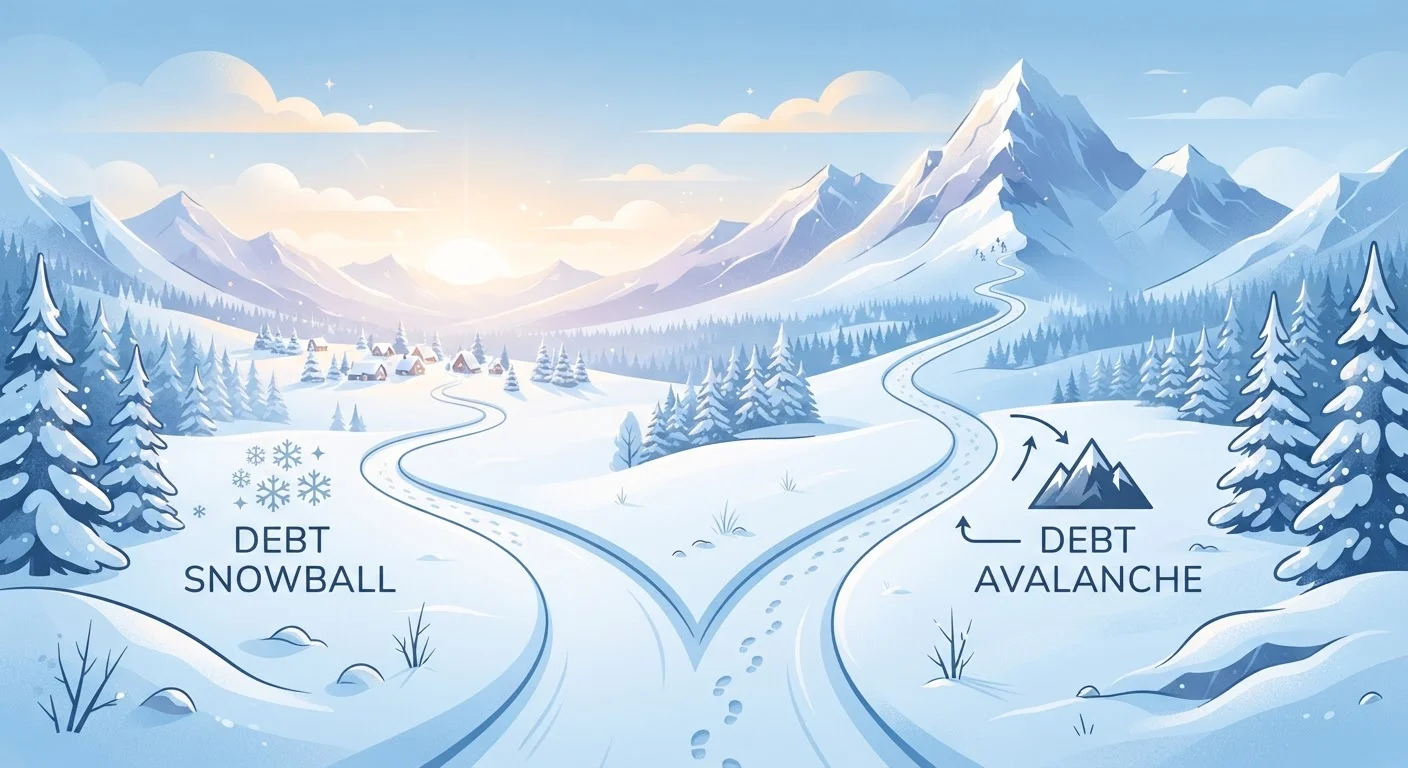
Both strategies follow the same foundational rule: pay minimums on every account, then direct any extra money toward one designated priority debt. Where they differ is in how that priority is chosen.
The debt avalanche ranks your debts by APR - the annual percentage rate that determines how much interest accrues each month. You focus extra payments on the account with the highest APR first, regardless of its balance. Once it's cleared, you roll that payment into the next-highest-rate debt. The logic is straightforward: the more expensive the debt, the more damage it does every month you carry it.
The debt snowball ignores interest rates entirely and ranks debts by outstanding balance, smallest to largest. You attack the smallest balance first, eliminate it, then "snowball" that freed-up payment toward the next-smallest. The appeal isn't financial efficiency - it's the motivational boost of crossing accounts off your list. Behavioral economists, including researchers whose work underpins the CFPB's consumer education materials, have noted that small wins can strengthen financial commitment over time.
Before choosing, it helps to understand what kind of debt you're dealing with. Our guide on the difference between good debt and bad debt explains why context matters when prioritizing repayment.
| Criterion | Debt Avalanche | Debt Snowball |
|---|---|---|
| Priority order | Highest APR first | Smallest balance first |
| Total interest paid | Lower (mathematically optimal) | Potentially higher |
| Speed to first payoff | Slower if top debt is large | Faster - smallest clears quickly |
| Psychological benefit | Delayed gratification | Early wins build momentum |
| Best debt profile | Few debts with wide rate gaps | Many accounts with varied balances |
| Complexity | Requires tracking APRs | Simple balance ranking |
The Real Trade-Off: Money vs. Motivation
In a purely mathematical world, avalanche wins every time. By eliminating high-interest balances first, you reduce the total interest paid across the life of your debts. For someone carrying high-rate credit card debt alongside a lower-rate personal loan, the savings can be meaningful - sometimes hundreds of dollars depending on balances and rates.
But personal finance is rarely a purely mathematical exercise. A 2016 study published in the Journal of Marketing Research found that people who focused on paying off smaller accounts first were more likely to eliminate their total debt than those who used a purely interest-rate-driven approach. The implication: a plan you abandon early costs more than a slightly less efficient plan you actually complete.
20%+
Typical APR on credit card debt
The Federal Reserve reports that average credit card interest rates have exceeded 20% APR in recent years, making high-rate debt especially costly to carry.
77%
Americans carrying some form of debt
According to Pew Research Center data, a large majority of American households carry at least one form of debt, from credit cards to auto loans.
Neither method works if you're also adding new debt. Before starting either strategy, it's worth reviewing whether saving while repaying debt makes sense for your situation - particularly if you lack an emergency fund.
Choosing the Right Path for Your Situation
A few practical questions can help clarify which approach fits:
- How spread out are your interest rates? If most of your debts carry similar APRs, the avalanche's mathematical edge shrinks - and snowball's motivational advantage may tip the balance.
- How many accounts do you have? Many small balances often respond well to the snowball. Fewer, larger balances with wide rate differences favor the avalanche.
- What's your track record with long-term plans? If you've struggled to maintain financial habits in the past, early wins from the snowball can serve as a real accountability tool.
Some people split the difference by starting with the snowball to clear one or two small accounts, then switching to the avalanche once they feel established. This hybrid isn't standard advice, but it reflects a realistic truth: the mechanics matter less than sustained follow-through.
Both Methods Require the Same Foundation
Neither the avalanche nor the snowball works without a clear picture of what you owe. Before you begin, list every debt with its balance, minimum payment, and APR. This inventory - sometimes called a debt register - is where both strategies start. Unfamiliar with terms like APR or amortization? Our personal finance terms reference covers the key vocabulary in plain language.
If managing multiple debts feels overwhelming, debt consolidation is another option worth understanding - though it comes with its own trade-offs. And once you've paid off debt, the principles for staying out of it are just as important as the payoff itself; see our guide on keeping debt from coming back.
This article is for general informational and educational purposes only and does not constitute personalized financial advice. Consult a qualified financial professional for guidance tailored to your individual circumstances.