
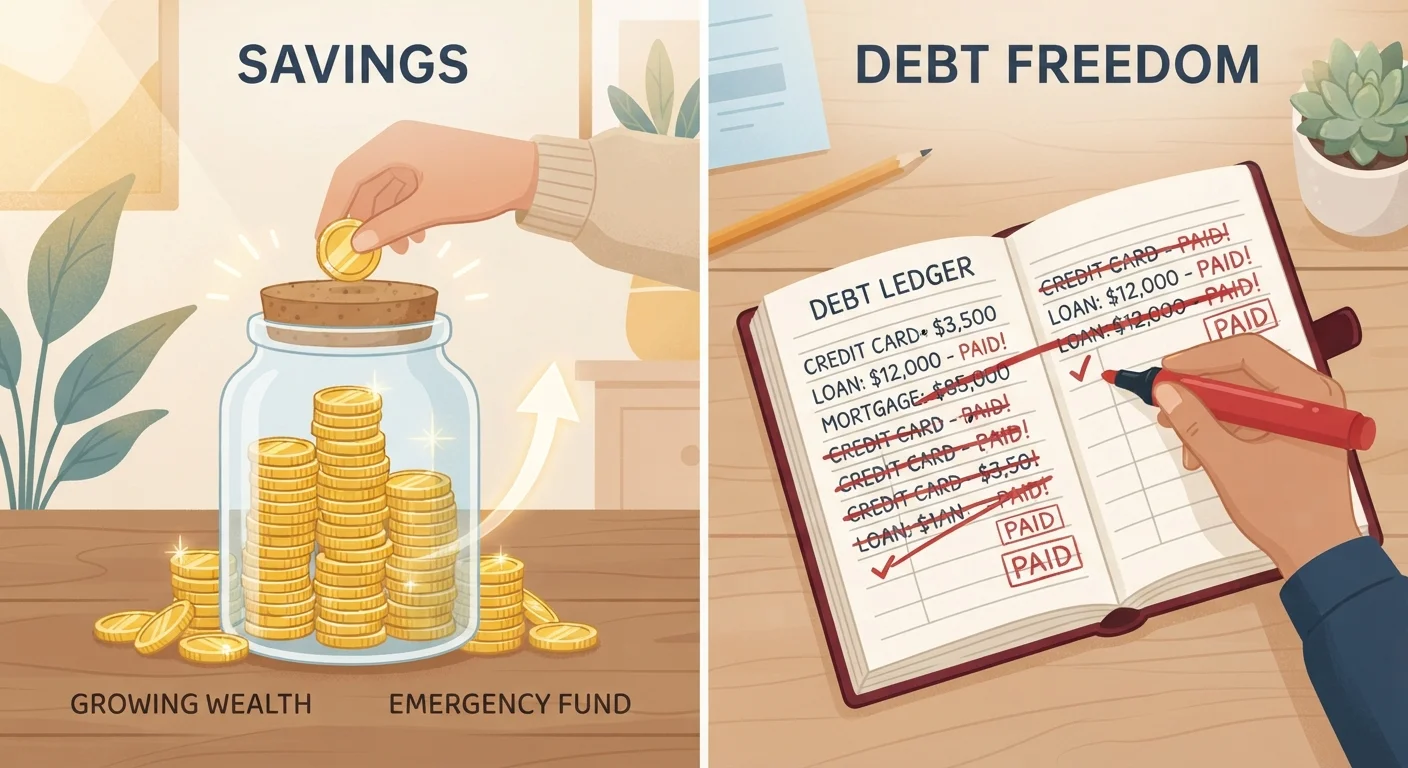
The Core Trade-Off: Interest Rates Are the Starting Point
The tension between saving and paying down debt comes down to one question: which rate is higher - the interest your debt charges you, or the return your savings would earn? Because compound interest works in both directions - building wealth in savings and compounding costs in debt - this comparison matters enormously. See our explanation of compound interest for savers and borrowers for a deeper look at the math.
As a rule of thumb: if your debt's interest rate is higher than what a savings account or conservative investment would realistically yield, paying down debt first produces a better net outcome. A credit card charging 22% APR is nearly impossible to beat with a savings account yielding 4-5%. In that scenario, every extra dollar toward the balance is effectively a guaranteed 22% return - no investment offers that with certainty.
However, this arithmetic view misses a critical variable: financial risk. A household with zero savings is one car repair or medical bill away from putting new charges on that same high-rate card - instantly erasing weeks of paydown progress.
Why a Minimal Emergency Fund Changes the Equation
Financial researchers and consumer advocates consistently emphasize that the absence of any liquid savings is itself a debt risk factor. The Consumer Financial Protection Bureau (CFPB) has noted that households without emergency savings are more likely to turn to high-cost credit when unexpected expenses arise.
This is why many personal finance frameworks recommend building a small cash buffer - often cited in the $500-$1,000 range - before accelerating debt paydown, rather than waiting until debt is eliminated to save anything at all. Think of it as a financial firewall: it keeps a single setback from becoming a new debt spiral.
Start With a Targeted Mini-Fund
Before deciding how to split surplus dollars, consider setting a specific, small savings target - such as one month of essential expenses - before accelerating debt payments. This modest cushion dramatically reduces the likelihood that an unexpected expense forces you back into high-rate borrowing. Once that cushion is in place, redirect additional cash toward your highest-interest debt.
If your income varies month to month, the calculus shifts further toward maintaining savings alongside debt payments. Our guide on managing debt and savings on a variable income walks through strategies tailored to irregular paychecks. For a step-by-step approach to building that buffer on a tight budget, see building an emergency fund inside a tight budget.
Comparing the Three Main Approaches
Most households effectively choose among three strategies, whether consciously or not. Here's how they stack up:
| Debt-First | Save-First | Hybrid Approach | |
|---|---|---|---|
| Best suited for | High-interest debt holders | Low-rate debt, employer match available | Most mixed-debt situations |
| Emergency fund risk | High if fund is empty | Low | Moderate - fund builds gradually |
| Interest cost reduction | Fastest | Slowest | Moderate |
| Savings growth speed | Delayed | Fastest | Steady but slower |
| Psychological sustainability | Motivating but risky without buffer | Calming but costly if rates are high | Balanced for most people |
| Handles income disruption | Poorly without savings | Well | Reasonably well |
The debt-first approach makes the most sense when interest rates on debt are high (generally above 7-8%) and a minimal emergency fund is already in place. The save-first approach is rarely optimal under high-rate debt but can make sense when debt carries low interest and employer retirement matching is available - that match is a guaranteed return that's hard to beat. The hybrid approach is the most widely applicable: make minimum payments on all debts, contribute a set amount to savings each month, and direct any surplus toward the highest-rate debt. This mirrors the logic behind the debt avalanche and snowball methods - structured but flexible.
One Exception That Almost Always Applies: Employer Retirement Matching
If your employer offers a 401(k) match and you're not contributing enough to capture it fully, that's usually worth prioritizing - even ahead of extra debt payments. A 50% or 100% match is an immediate, guaranteed return on your contribution that no debt paydown strategy can replicate. Forgoing it is, in effect, leaving part of your compensation on the table.
~56%
Americans who lack sufficient emergency savings
Federal Reserve surveys have consistently found that a majority of U.S. adults could not easily cover a $400 unexpected expense from savings alone.
20-100%
Typical employer 401(k) match range
Many U.S. employers match employee contributions at rates between 20% and 100% up to a set percentage of salary - representing an immediate return no savings rate can reliably match.
Once you've captured the full match, the interest-rate comparison described above should guide how you split remaining dollars between savings and debt. This framing - not a one-size-fits-all prescription - is what sound financial education looks like. For context on how different debt types factor into this decision, see the difference between good debt and bad debt.
This article is for general informational and educational purposes only. It does not constitute personalized financial, tax, or investment advice. Consult a qualified financial professional before making decisions specific to your situation.