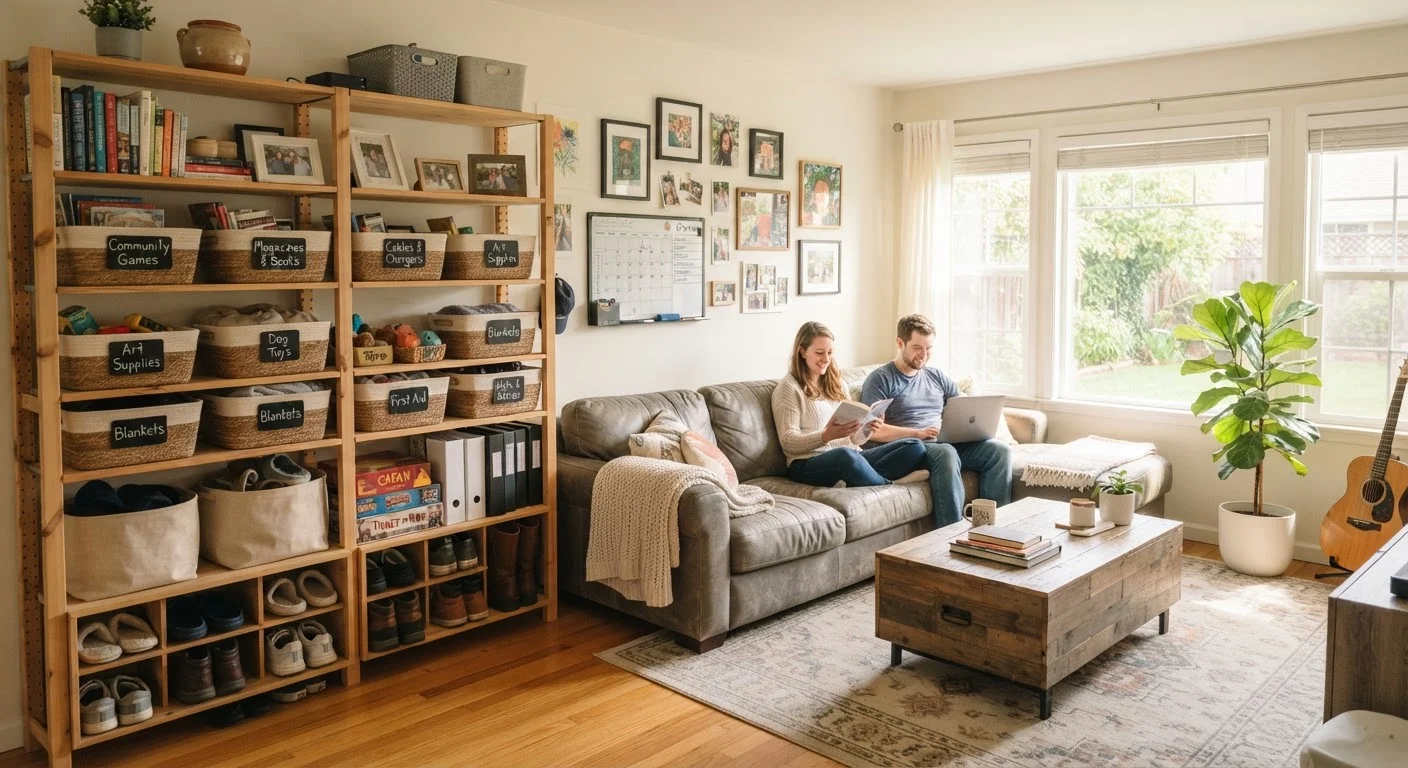
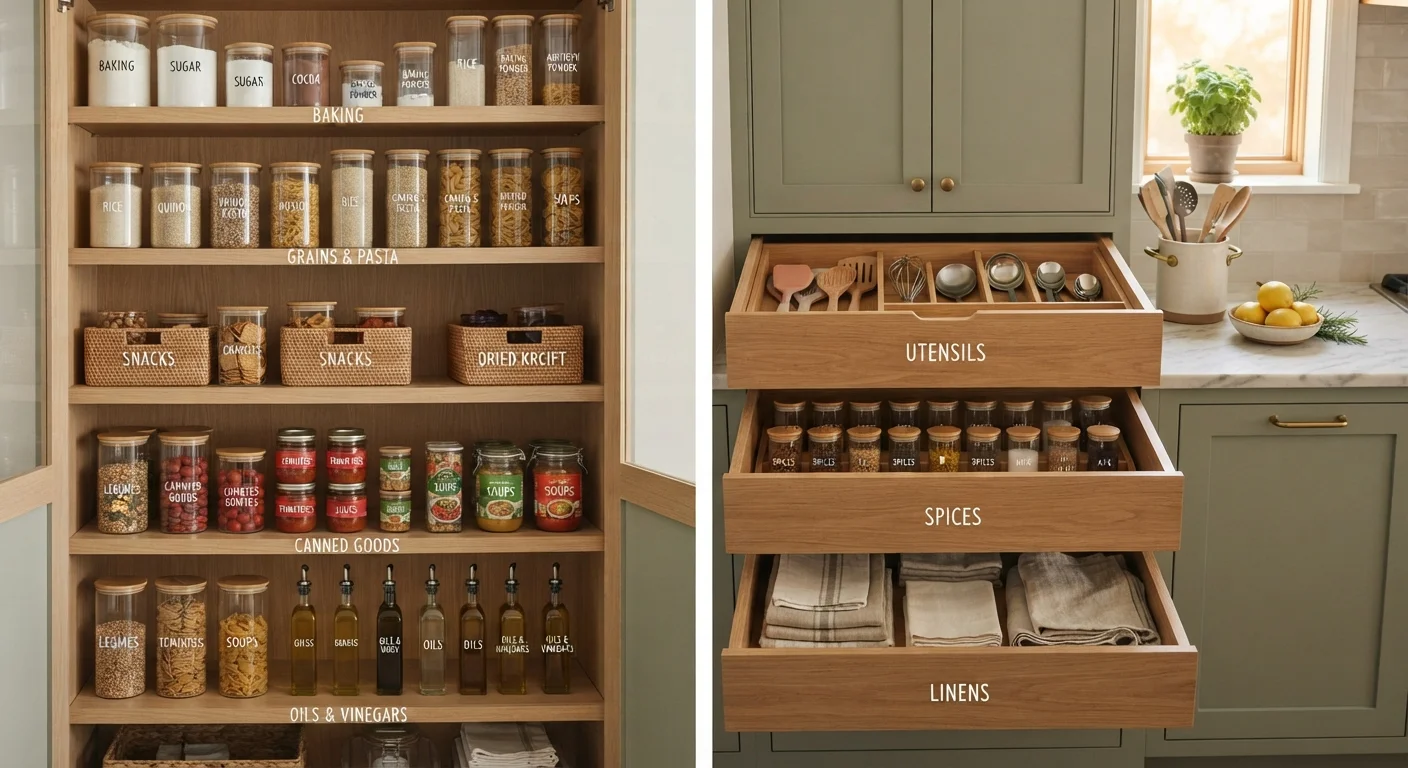
What Each Approach Actually Means
Category organization means grouping items by what they are. All batteries in one drawer. All first aid supplies in one bin. All craft supplies on one shelf - regardless of which room you use them in. It's the logic behind a hardware store: find anything in its type-based aisle.
Location organization means storing items where they're actually used. Scissors by the gift wrap. A phone charger on the nightstand. Sunscreen by the back door. The logic here is friction reduction: you reach for something and it's already there.
Both methods feel intuitive until you try to live with them exclusively. A home organized entirely by category can mean walking to three different rooms to complete one task. A home organized purely by location can scatter duplicates everywhere and make shared-use items nearly impossible to find.
Where Category Organization Has the Edge
Category organization works best when findability is the primary concern. If someone else in your household needs to locate something without asking you, categories create a predictable logic they can follow independently. This makes it especially valuable in shared homes - a topic worth exploring more in our guide to organizing shared living spaces.
It also shines for items used across multiple locations. Tools, medications, office supplies, and cleaning products often move around the house. Anchoring them to a single categorical home prevents the "I thought you had it" problem.
Finally, category organization supports inventory awareness. When all your batteries or all your batteries are in one place, you immediately see what you're running low on. Scattered by location, the same items disappear into context and go unnoticed until you need them urgently.
Test Before You Commit
Before reorganizing an entire room, try your chosen method on one drawer or cabinet for two weeks. Notice whether items get put back reliably, whether others in your household can find things without help, and whether the system creates new problems. Small pilots reveal friction points that a full reorganization would entrench.
Where Location Organization Wins
Location organization reduces the number of decisions required to complete a routine task. When everything needed for a morning routine is at the bathroom sink, you don't have to think. This is its central strength: it lowers the cognitive load of repetitive, daily actions.
For workspaces especially, point-of-use storage can meaningfully improve focus and flow. A well-organized home office, for example, keeps active project materials within arm's reach and reference materials nearby - not in a general "supplies" closet down the hall. See our piece on setting up a home office that supports focus for a practical application of this principle.
Location organization also works well in homes with children or elderly family members, where reducing steps and simplifying access matters more than inventory elegance.
| Category Organization | Location Organization | |
|---|---|---|
| Core logic | Group by item type | Store at point of use |
| Best for | Shared or infrequently used items | Daily routines and high-use areas |
| Findability | High - predictable for everyone | High only if you remember usage context |
| Daily friction | Can require extra trips across rooms | Minimizes steps and decisions |
| Works well in shared homes | Yes - common logic anyone can follow | Depends on consistent habits |
| Risk when overused | Items scattered across multiple category homes | Duplicate items piling up everywhere |
How to Combine Both Methods Strategically
The most functional home organization systems aren't purely one or the other - they use location as the primary organizing layer and category as a secondary one within each location. Think of it as zones first, categories within zones.
Your kitchen might have a baking zone (location) that contains measuring cups, baking soda, and parchment paper grouped together (category within the zone). Your entryway might have a go-bag zone with keys, masks, umbrellas, and reusable bags - items grouped by their shared purpose of leaving the house.
This zoning-plus-category structure is discussed in depth in our article on using zones to make every room work harder. When you assign clear activity zones to areas of a room, you get the retrieval benefits of location logic and the findability benefits of categorical grouping.
~23 min
Average time lost daily searching for items
Organizational research has estimated that adults lose roughly 20-30 minutes per day looking for misplaced items at home and work.
2-3x
More likely to sustain a system that reduces daily decisions
Behavioral research consistently finds that lower-friction habits are significantly more likely to be maintained long-term.
The practical rule: if an item has one primary use location, store it there. If it genuinely travels between locations or is shared by multiple people, give it a categorical home and let everyone know where that is.
Choosing What's Right for Your Household
Before committing to either approach, consider three questions: Who else uses these items? How often? And what's the consequence when something can't be found quickly?
A single person in a small apartment may find location organization intuitive and sufficient - there aren't many locations to manage. A family of four in a larger home almost certainly needs categorical anchors for shared supplies, or things will consistently disappear.
Don't over-engineer the decision. The best organizing system is one that people in your household will actually use and maintain without constant effort. Start with your highest-friction area - the junk drawer, the linen closet, the bathroom cabinet - apply one of these frameworks, and observe whether it actually reduces confusion over the following few weeks. Adjust from there rather than overhauling everything at once.
Storage orientation choices, like whether to go vertical or horizontal with your storage, add another layer to this thinking - our overview of vertical vs. horizontal storage approaches can help you think through the physical side of implementing whichever organizational logic you choose.